
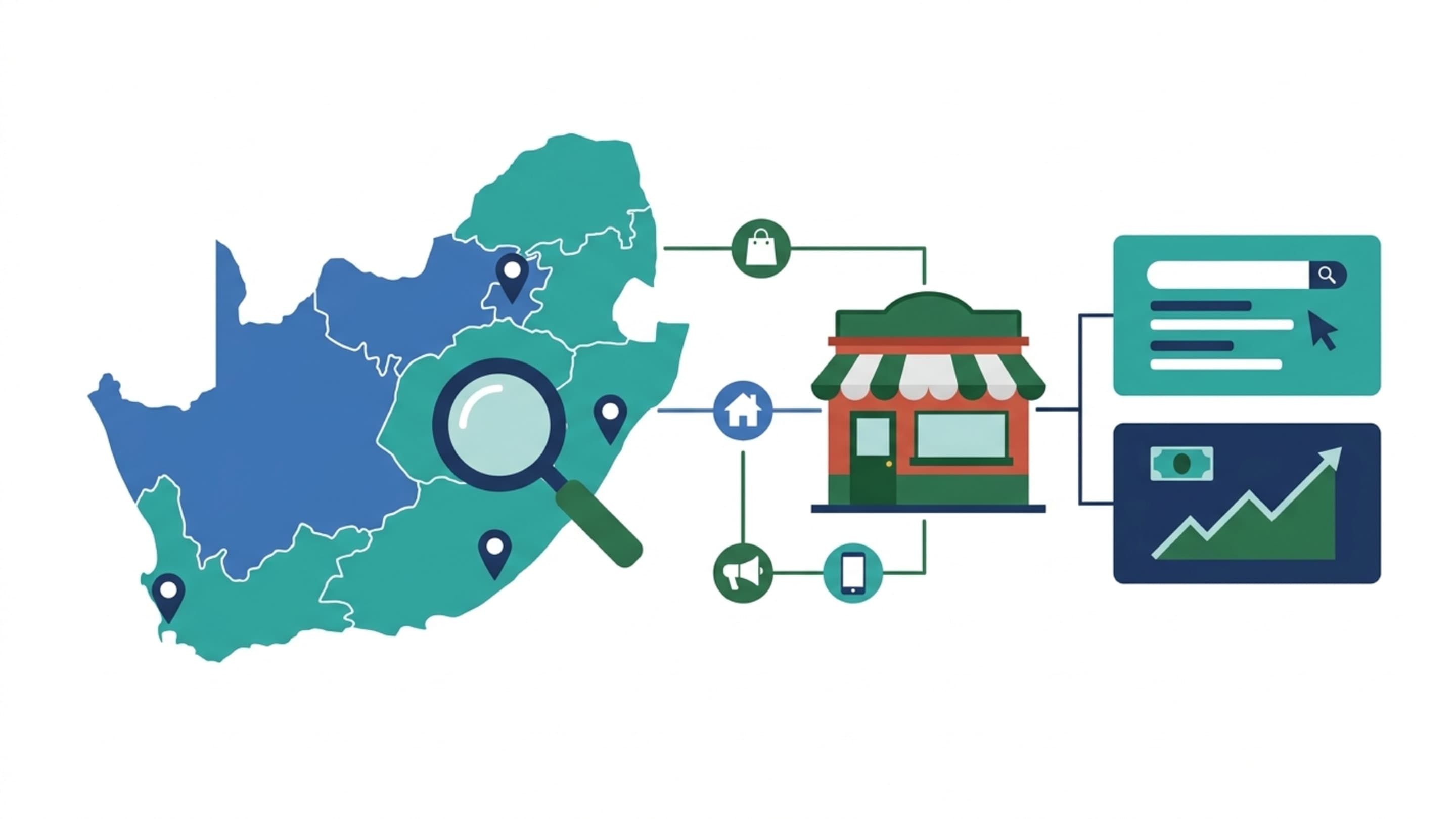
The Scenario: A Roodepoort Operator Who Cannot Reconcile the Numbers
Picture a Roodepoort business - say a home-services operator working Wilgeheuwel and Constantia Kloof, or a small Shopify store near Clearwater Mall - running Google Ads on an illustrative budget in the region of R15,000-R40,000 per month, either set up directly or handed to a freelancer. The dashboard says the campaign produced a certain number of conversions last month. The owner opens the bank feed and the numbers do not line up.
That gap is the actual brief. Not "which agency in Roodepoort has the best logo", but who can make the platform's numbers explainable against the business's own revenue. This piece maps the first 90 days of that handover as a sequence of decisions, because that is the order in which risk arrives.
Why a 'Roodepoort Agency' Question Is Really an Accountability Question
Roodepoort is not a marketing island. It sits inside the City of Johannesburg metro, so a buyer typing "plumber near me" in Florida may sit inside the same auction as one in Northcliff or Randburg. The local qualifier matters less than three things: who owns the ad account, whether the conversion signal is real, and whether anyone is reconciling spend against revenue. A local agency that cannot answer those is a local agency with a phone number.
If an agency insists on building the Google Ads account under their own login and you never receive admin access, treat it as a red flag. Ownership should sit with you from day one.
Day One Handover: The Access Checklist Most Briefs Skip
Before a single bid changes, secure the assets. An agency should request access, not custody.
| Asset | Who should own it | Why it matters |
|---|---|---|
| Google Ads account (via MCC link) | Client | Ad history and billing stay portable |
| GA4 property admin | Client | Attribution and audience data live here |
| Merchant Center & Search Console | Client | Feed and organic diagnostics |
| CRM / lead source field | Client | Closed-revenue truth for lead quality |
| Google Business Profile | Client | Physical or service-area location signals |
Two Kinds of Roodepoort Advertiser: Service-Area Business vs Storefront Retail or E-commerce
A service-area business that drives to customers should hide its address and define service areas, per Google Business Profile guidance. A storefront or e-commerce operation wants the physical pin, location extensions and distance-based relevance. The targeting logic differs: the first buys intent inside a travel radius, the second buys footfall or delivery catchment. Getting this wrong wastes the first month.
The Roodepoort-Specific Audit: Auction Overlap and Suburb-Level Targeting
A common early finding is over-segmented geo-campaigns - a separate campaign for each of Roodepoort, Krugersdorp, Florida and Little Falls - each throttling the other in the auction. Auditing impression share and overlap usually reveals fragmented budgets bidding against themselves. Suburb-level negatives, meanwhile, do earn their place: excluding areas outside your delivery or travel range is legitimate; excluding a neighbouring suburb because it "feels far" often isn't.
Location Targeting Radius vs Johannesburg-Wide Presence (With a Decision Table)
| Situation | Illustrative setting | Trade-off |
|---|---|---|
| Mobile home services, limited fleet | Presence within a defined radius | Lower reach, better response times |
| High-ticket service, low job volume | Johannesburg metro + suburb exclusions | Wider reach, sharper negatives |
| Storefront retail / e-commerce | Location + radius with separate campaigns | Footfall vs delivery separates cleanly |
Review the location targeting options before narrowing a radius - presence-based targeting behaves differently from interest-based.
The Tracking and Consent Build: POPIA, Consent Mode and Where Conversion Truth Lives
Month one is mostly plumbing. Under South Africa's POPIA, a cookie banner must reflect real choices, and Google's Consent Mode must be wired to it so modelled conversions degrade gracefully instead of vanishing. For e-commerce, a server-side tag through a GTM server container closes much of the browser-loss gap; for lead-gen, a CRM stage field matters more than a clever pixel.
Then reconcile attribution. Platform-reported conversions and GA4 data-driven attribution will never match the bank exactly. The job is to know the size and direction of the gap and report against it honestly.
Define one primary conversion per business goal before go-live. Multiple "primary" actions inflate totals and confuse Smart Bidding.
First Restructure: Splitting Search From Performance Max Without Losing Volume
Accounts that leaned on Performance Max alone often cannot see which search terms convert. The restructure splits branded Search, non-brand Search and PMax, with negative lists and audience signals shared so the asset groups learn faster. Volume dips briefly; that is the cost of visibility, and it should be planned rather than panicked about.
How to Read the 30, 60 and 90-Day Report Against Your Own Revenue
Ask for a report that anchors on revenue, not clicks. Month one: tracking health and reconciled conversion counts. Month two: CPA trend by campaign and lead-quality feedback from sales. Month three: marginal return - what the last rand of spend produced. Prebo Digital's custom reporting approach is built around exactly this reconciliation, not a screenshot of a dashboard.
Defining Success in Rand: Reconciled Conversions, CPA Trend, MER and Lead Quality
For storefront and e-commerce accounts, marketing efficiency ratio (total revenue ÷ total marketing spend) is a sturdier headline than platform ROAS, which ignores margin and often double-counts. For lead-gen, a shrinking CPA on declining lead quality is not success. Set the target in rand: a reconciled cost per booked job, a stable or improving CPA trend, and a lead-quality ratio the sales team confirms.
Where a Johannesburg-Based Partner Fits (and How Prebo Digital Works)
Prebo Digital was founded in May 2016 by an ex-Google employee and is Johannesburg-based, so a Roodepoort advertiser gets metro familiarity without a commute. The agency holds Google Premier Partner status (2022-2026), is a verified Amazon Ads Partner, and carries Meta, Shopify, Microsoft Advertising, ProfitMetrics and VWO certifications. Its Google Ads service follows a strategy, build, test, scale and report cadence, and the case studies show the working pattern. If the reconciliation problem above sounds familiar, a conversation via the contact page is the sensible next step.
Any ZAR figures in this article are illustrative estimates for planning, not quoted fees or promised outcomes. Confirm scope, budget and reporting cadence in writing before signing.