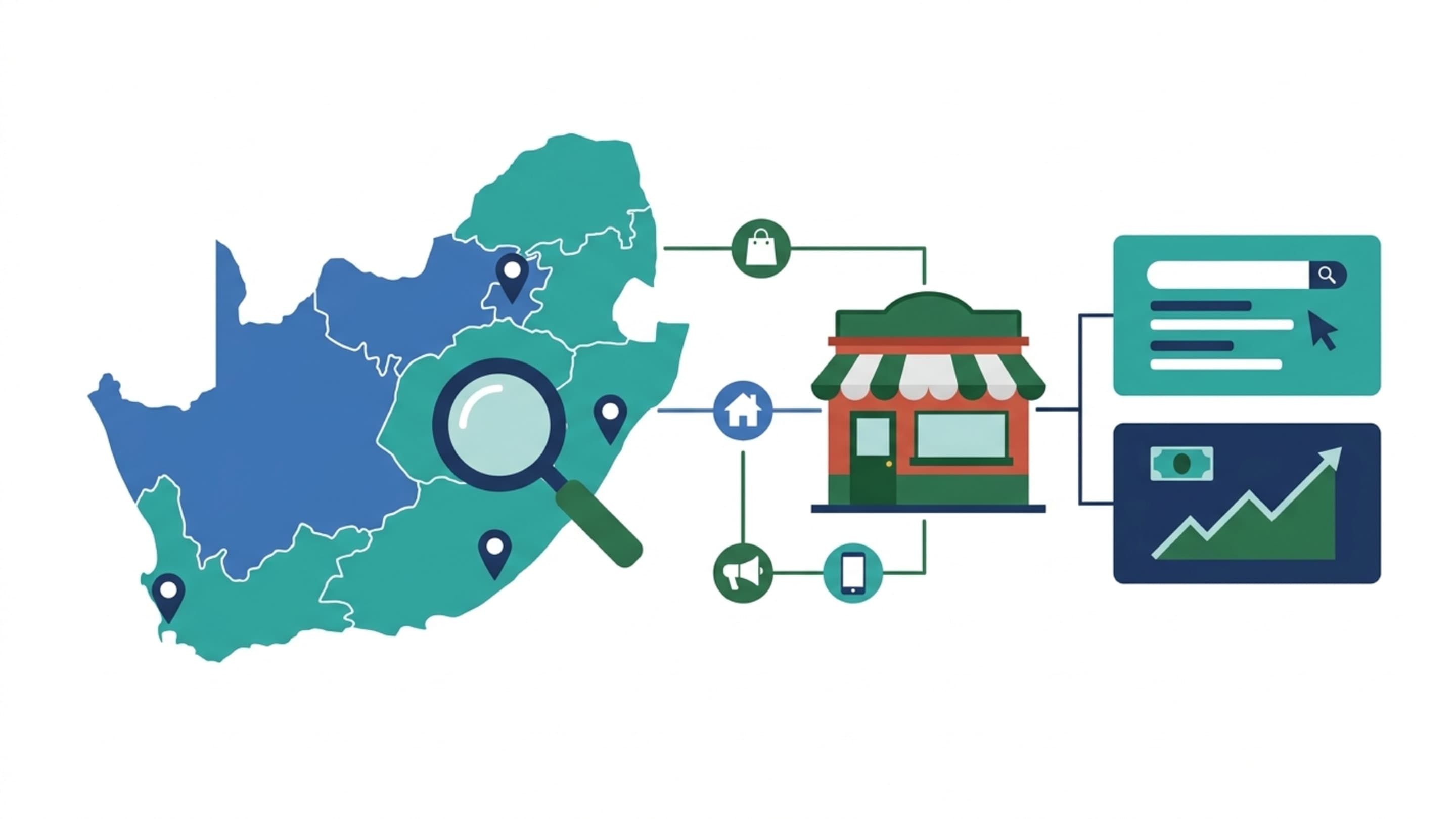

The Scenario: A Cape Town Operator About to Sign a PPC Retainer
Picture a hypothetical Cape Town tour operator in the V&A Waterfront selling small-group Winelands trips into Germany and the UK, with a modest direct-booking site on Shopify. Three proposals sit on the table: a flat monthly fee, a percentage of ad spend, and a hybrid with a performance kicker. All claim 'full-service PPC'. None explain how conversions will be tracked, who owns the Google Ads account, or how the southern-hemisphere summer peak will be handled.
That gap is the real decision. When marketing directors search for PPC Cape Town, they want a way to compare providers without being sold to. This guide covers the commercial detail proposals leave out: ZAR fee ranges, incentive structures, the tracking build that must precede spend, and what a disciplined first 90 days delivers.
Why Cape Town PPC Is Not Just 'South African PPC'
Cape Town concentrates a specific advertiser mix: tech and SaaS, inbound tourism and hospitality, DTC brands shipping into the EU and UK, creative and professional services, health and wellness, short courses and property. Most sell across borders, which changes the brief:
- Conversion values need multi-currency handling (ZAR revenue, EUR and GBP bookings).
- Reporting must reconcile multiple time zones, not just SAST.
- Consent must satisfy POPIA for South African visitors and UK GDPR for British traffic - usually a consent-mode setup, not a single banner.
- Geo-segmentation matters more than in a domestic account: a German search for 'Cape Town wine tour' and a local search for 'wine tour Cape Town' warrant different landing pages, languages and bids.
A PPC programme built only for South African search behaviour will systematically underperform for any Cape Town advertiser whose revenue arrives in GBP or EUR.
What a Cape Town PPC Engagement Should Actually Cost (ZAR Ranges)
Treat these as rough estimates; they vary by scope, media budget, currency and measurement work. Split every proposal into management fee, media budget (passed through at cost), and a one-off setup and tracking build.
| Component | Typical ZAR range (estimate) | What it covers |
|---|---|---|
| Monthly management fee | R8,000 - R35,000+ | Strategy, build, optimisation, reporting cadence |
| One-off tracking & consent build | R10,000 - R40,000+ | GA4 events, Enhanced Conversions, server-side, consent |
| Media budget | Client-owned, passed through | Google, Meta, Microsoft spend |
The warning sign is a cheap retainer bundling 'tracking' with no line-item cost. A proper measurement build involves developer time, tag configuration and reconciliation testing - rarely free.
Fee Models Compared: Flat Retainer, Percentage of Spend, Hybrid
| Model | Predictability | Best-fit band | Incentive risk |
|---|---|---|---|
| Flat retainer | High | Smaller budgets | Low, but scope creep can cap effort |
| % of ad spend | Medium | Mid to large accounts | Encourages spend growth, not efficiency |
| Hybrid / performance-linked | Lower | Mature accounts | Only works if the outcome is precisely defined |
Percentage-of-spend misaligns at both extremes: too small to fund real work, or large enough that agency revenue depends on the client spending more. Any performance element must define the measured outcome - profit-margin-adjusted ROAS or a CRM-verified booked tour - not clicks.
What a Tracking and Consent Build Must Include Before Any Spend Goes Live
Demand a live reconciliation test, not a screenshot. The build should map GA4 events to platform conversion actions, run Enhanced Conversions where user data is lawfully collected, and respect consent state - consent-mode signals for UK traffic alongside POPIA-compliant handling of South African visitors.
How to Read a Cape Town PPC Proposal in Ten Minutes
Check five things: verifiable partner credentials (Google Premier Partner status can be confirmed in Google's public directory), whether ad accounts sit in your name, evidence of cross-market capability, lock-in and notice terms, and whether reporting reconciles against GA4 and your CRM. If any are missing, it is a media-buying quote, not a programme.
The First 90 Days: A Cape Town PPC Playbook
A credible engagement follows a fixed sequence rather than launching ads on day one.
- Days 1-14 - Audit and access. Review existing accounts, conversion setup, consent state and landing page speed; confirm account ownership sits with the client.
- Days 15-30 - Measurement build. GA4 event mapping, Enhanced Conversions, server-side where the store allows, consent-mode configuration, CRM handoff test.
- Days 31-45 - Architecture. Campaigns split by geography and language, with search alongside Performance Max and Meta in a structure that keeps observation possible.
- Days 46-75 - Controlled launch. Bid strategies chosen per campaign; budget flexed around the seasonal calendar; weekly search-term and placement pruning.
- Days 76-90 - First honest read. Reconcile platform-reported conversions against GA4 and CRM before scaling anything.
Campaign Architecture for a Multi-Market Cape Town Advertiser
For the Winelands operator, the architecture separates a ZA campaign (local intent, ZAR funnel) from UK and EU campaigns (English and German ad groups, GBP/EUR values, destination landing pages). Separate campaigns preserve bidding control and forecast accuracy; blending markets into one Performance Max asset group surrenders visibility of which market pays. Request a GA4-to-Enhanced-Conversions mapping table - documented event names, values and consent dependencies - not a vague promise of 'conversion tracking included'.
Building a Seasonality Calendar Around the Cape Town Trading Year
Flat annual budgets punish Cape Town advertisers. Inbound tourism and hospitality peak around December and January, aligned with the southern-hemisphere summer and northern-hemisphere holiday bookings; DTC brands often ride Black Friday and Q4 in the UK and EU. Flex bids and budgets around those windows, reviewing auction insights ahead of each peak rather than after it.
If a proposal contains no seasonality section, ask how budget will flex for December and Q4. A flat twelve-month plan is usually a plan for the wrong months.
Reporting That Survives Scrutiny: Platform vs GA4 vs CRM Reconciliation
Platform-reported conversions are directional, not definitive. Good reporting reconciles three sources - Google Ads or Meta, GA4, and the CRM or order system - then judges on MER, ROAS against contribution margin, and CAC/LTV. Prebo Digital's custom reporting approach is built around this reconciliation, with profit-level tracking handled through ProfitMetrics-style setups rather than revenue alone. See also the CRO and tracking work that closes the loop between click and checkout.
What Good and Bad Engagements Look Like by Budget Band
| Monthly media budget (estimate) | Credible engagement | Warning signs |
|---|---|---|
| Under R25,000 | One or two channels, lean but honest tracking, monthly review | 'All platforms' promises at this fee |
| R25,000 - R100,000 | Search + Performance Max + Meta, server-side tracking, fortnightly cadence | No reconciliation, agency-owned accounts |
| Above R100,000 | Multi-market structure, CRM-linked reporting, profit-level measurement | Lock-in beyond reasonable notice, no audit trail |
Choosing Between a Cape Town Agency, an In-House Team and a Remote Provider
In-house gives control but rarely covers Google, Meta and measurement at once. A remote provider can be excellent on price, but time-zone lag matters when December budgets flex and creative needs rebuilding mid-peak. A local agency earns its fee through proximity to the trading calendar and shared working hours. Prebo Digital is Johannesburg-based - founded in 2016 by an ex-Google employee - and serves Cape Town and multi-market advertisers across Africa, the UK and Europe. Review the Google Ads service scope before comparing quotes, and confirm every claim yourself.
Ask each provider for the last reconciliation they ran between platform conversions, GA4 and the client's CRM. The answer separates a paid media programme from a media-buying invoice.